
Law Firm Bookkeeping: In-House vs. Virtual Assistant vs. Outsourced (2026 OC Guide)

Choosing the right law firm bookkeeping model — whether you call it bookkeeping for attorneys, attorney bookkeeping, or working with a dedicated attorneys bookkeeper — is one of the most consequential decisions a managing attorney makes. The wrong choice does not just create messy books. It exposes the firm to State Bar IOLTA violations, surprise tax bills, and a forensic cleanup that can cost $10,000 or more to repair.
This guide walks Orange County law firm owners through the three real options for law firm
bookkeeping in 2026: hiring an in-house bookkeeper, using a virtual assistant (VA), or working
with an outsourced bookkeeping firm that specializes in attorneys. We compare true cost,
IOLTA risk, coverage, and growth fit so you can make a confident decision.
Irvine Bookkeeping has served Orange County attorneys for 16 years. Below is the framework
we use when a firm calls us asking which option fits their stage of growth.

In this guide |
The Three Law Firm Bookkeeping Options at a Glance
When a firm in Irvine, Newport Beach, Lake Forest, or anywhere across Orange County needs to fix its bookkeeping, there are really only three serious options. Every other variation is a hybrid of these three. Here is the quick comparison before we go deep.
Factor | In-House Bookkeeper | Virtual Assistant | Outsourced Firm (Specialized) |
True monthly cost | $5,500–$8,500 | $1,200–$3,000 | $1,500–$4,000 |
IOLTA expertise | Rare | Almost never | Standard |
Coverage if sick | You | You | Built-in team |
Growth ceiling | High | Low | High |
Best for firms | 10+ attorneys | Solo, low volume | 1–10 attorneys |
Why Generic Bookkeeping Fails Attorneys
Standard small business bookkeeping is built for a coffee shop or a contractor. It is built around one simple flow: money in, money out, reconcile the bank statement. Law firm bookkeeping is fundamentally different the moment a firm holds client funds, charges retainers, or advances case costs.
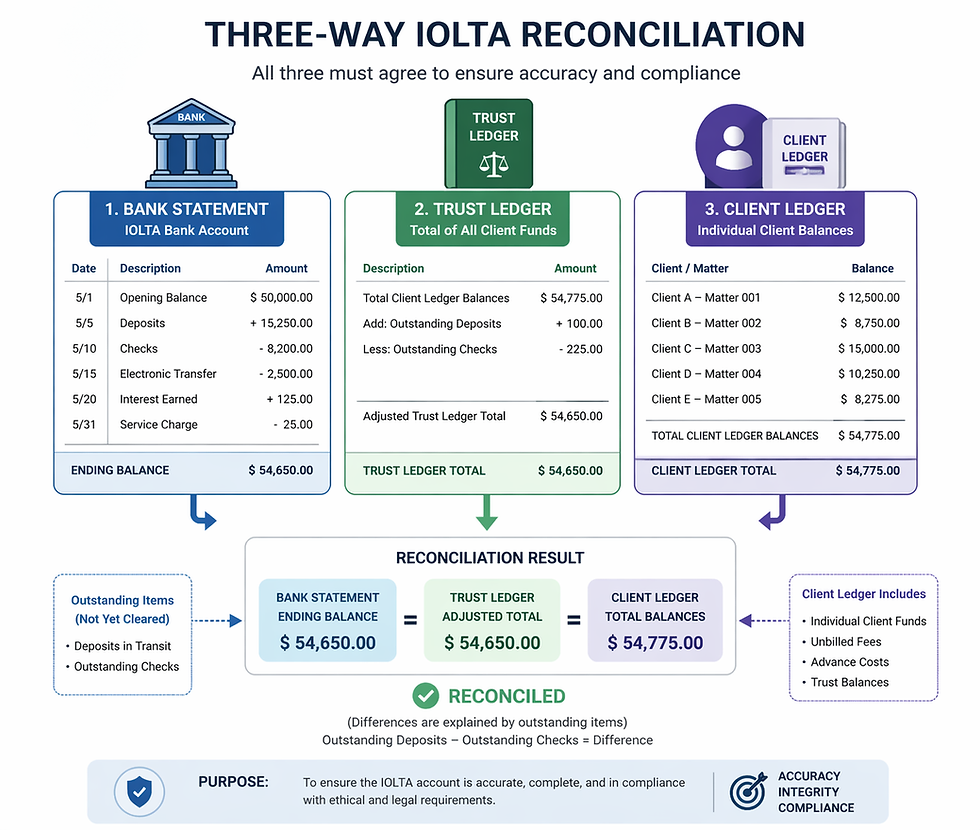
The State Bar of California requires every attorney holding client funds to maintain a separate IOLTA trust account and perform a monthly three-way reconciliation. That single requirement disqualifies most generalist bookkeepers and almost every virtual assistant on the market. A general bookkeeping for IOLTA account workflow does not exist. There is only specialized IOLTA bookkeeping or there is non-compliance.
Why this matters in 2026 California State Bar's CTAPP (Client Trust Account Protection Program) is now actively auditing attorneys. IOLTA accounting mistakes that used to sit quietly in the background now trigger random compliance reviews. The cost of a bad bookkeeping choice has gone up dramatically. |
Read the full requirements at the State Bar of California's CTAPP program page for the official rules.
Here are the four areas where generic bookkeeping falls apart for a law firm:
Retainers misclassified as income (creates phantom revenue and a tax surprise)
Settlements run through the operating account instead of IOLTA (instant State Bar violation)
Advanced client costs tracked as expenses instead of receivables (distorts profit margins)
No three-way IOLTA reconciliation (fails the basic compliance test)
Reconciling bank statements for law firms requires matching three sources — bank, trust ledger, and client ledgers — not just oneRead the full requirements at the State Bar of California's CTAPP program page for the official rules.
Here are the four areas where generic bookkeeping falls apart for a law firm:
Retainers misclassified as income (creates phantom revenue and a tax surprise)
Settlements run through the operating account instead of IOLTA (instant State Bar violation)
Advanced client costs tracked as expenses instead of receivables (distorts profit margins)
No three-way IOLTA reconciliation (fails the basic compliance test)
Reconciling bank statements for law firms requires matching three sources — bank, trust ledger, and client ledgers — not just one
Option A: The In-House Bookkeeper
Hiring an in-house bookkeeper means putting a full-time or part-time employee on payroll, sitting in your office or working remotely as a W-2 employee. This is the model most large firms eventually move to once they cross 10+ attorneys and need someone physically present to chase paperwork, cut checks, and field daily questions from staff.
The pros of an in-house bookkeeper
Available in real time for daily questions and document chasing
Learns your firm's specific quirks and partner preferences
Can absorb adjacent admin tasks like vendor management or payroll prep
Reports directly to the managing partner with no coordination friction
The cons of an in-house bookkeeper
Most are generalists hired for a specialist's job — true IOLTA expertise is rare on the open market
Single point of failure: if they are sick, on vacation, or quit, your books stop
Role creep is inevitable — they end up as a hybrid office manager, and the monthly close slips first
Total cost of ownership (salary + taxes + benefits + management time) is the highest of the three options
Requires a senior accountant or CPA above them to audit and validate the work
Real OC market cost (April 2026) A qualified law firm bookkeeper in Orange County earns $58,000 to $78,000 base salary. Add 22 percent for payroll taxes, healthcare, retirement match, and PTO and you are at $71,000 to $95,000 fully loaded. Divide by 12 months and your real monthly cost is $5,900 to $7,900 — before you account for the cost of a CPA reviewing their work. |
Option B: The Virtual Assistant
A virtual assistant (VA) is an offshore or domestic contractor who handles general administrative work and basic data entry. They are positioned as the affordable, flexible option for solo attorneys and small firms who cannot justify a full-time hire. The promise is simple: a Swiss Army Knife who handles intake, scheduling, AND your books for one low hourly rate.
In practice, the VA model breaks down quickly when applied to law firm bookkeeping. Here is what we see when firms call us to clean up after a VA experiment.
Where the virtual assistant model fails attorneys
VAs are paid $8 to $25 per hour and are explicitly hired for breadth, not depth — IOLTA expertise is essentially never present
The 'jack of all trades' trap: when one person handles ten tasks, reconciliation is the first thing to slip
High attorney oversight burden — you spend billable time managing their work, often more than you save
No internal review or quality control — what they enter goes straight to your books
Cleanup costs eclipse any savings: a typical attorney cleanup bookkeeping engagement after a failed VA experiment runs $3,000 to $8,000
When a VA actually works
To be fair, there is a narrow case where a VA model is acceptable: a true solo practitioner with zero trust account activity, fewer than 30 transactions per month, and personal time to review every entry. If your firm has any IOLTA activity, contingency fee work, or more than one attorney, the VA model is not viable for IOLTA bookkeeping services.
Option C: Specialized Outsourced Bookkeeping for Law Firms
The third option is hiring an outsourced bookkeeping firm that specializes in attorneys bookkeeping. Whether your firm handles general litigation, personal injury law firm bookkeeping, family law, or transactional work, this model is built around the recurring rhythm of monthly close, IOLTA reconciliation, and CPA-ready reporting. This is what we do at Irvine Bookkeeping. Instead of hiring a single person, you hire a system: a team of bookkeepers, an internal reviewer, and a defined monthly close process built specifically for law firm bookkeeping.
What you actually buy when you outsource
Industry-native expertise — your bookkeeper already knows IOLTA, advanced costs, contingency fees, and Rule 1.15
Built-in coverage — if your primary contact is on vacation, the system continues without you noticing
Internal quality review before reports hit your desk — every month is reviewed by a senior accountant before delivery
Flat monthly fee with predictable budgeting — no payroll taxes, no benefits, no surprise costs
Software subscription costs absorbed by the firm in most cases
No management drag on the attorney — you receive clean reports and approve them
The honest tradeoffs
Not in your office to grab the mail or manage day-to-day admin — you still need a receptionist or office manager for those tasks
Requires clean digital communication and a shared document system (we use a secure portal)
Best fit is firms with 1 to 10 attorneys — beyond that, you may want a hybrid with one in-house controller plus an outsourced team for execution
What good bookkeeping for attorneys actually looks like Monthly close completed by the 10th. Three-way IOLTA reconciliation in State Bar format. Client ledgers maintained as liability accounts. Advanced costs tracked as receivables. Settlement disbursements properly recorded. CPA-ready package every quarter. If your current bookkeeper does not deliver all of this, you do not have law firm bookkeeping. You have generic bookkeeping with a law firm logo on the invoice. |

True Cost Comparison: Real Orange County Numbers
This is where most comparison guides get vague. We will give you the real Orange County numbers we see every month when firms call us asking what their current setup actually costs them. The sticker price is never the real price.
Cost line | In-House | Virtual Assistant | Outsourced Firm |
Direct labor | $5,800 base | $1,400 (60 hrs) | $2,500 flat |
Payroll taxes & benefits | $1,300 | $0 | $0 |
Software & subscriptions | $180 | $180 (you pay) | Included |
CPA review time | $400 (1 hr) | $800 (2 hrs) | Built in |
Attorney management time | $500 | $1,200 | $200 |
Cleanup risk amortized | Low | $300/mo avg | None |
TRUE MONTHLY COST | $8,180 | $3,880 | $2,700 |
The numbers tell a story Orange County attorneys often miss: a virtual assistant looks cheap on paper but the true cost lands close to outsourcing once you add CPA review and your own management time. Outsourced law firm bookkeeping consistently delivers the lowest true cost AND the lowest IOLTA risk.
IOLTA Risk by Bookkeeping Model
Cost is one half of the decision. The other half is the cost of being wrong. With CTAPP enforcement now active and the State Bar performing random reviews, the financial impact of a single IOLTA mistake far exceeds any savings on a cheaper bookkeeping option.
In-house bookkeeper IOLTA risk
Risk level: Medium. Your in-house bookkeeper either knows IOLTA or they do not. Most do not. The fix is hiring above market or paying a CPA monthly to review their work — both expensive.
Virtual assistant IOLTA risk
Risk level: High. We have not seen a single VA arrangement in 16 years that produced a clean three-way IOLTA reconciliation in State Bar format. The math does not work — IOLTA expertise costs $60+ per hour and VAs are priced at $8 to $25 per hour.
Specialized outsourced bookkeeping IOLTA risk
Risk level: Low. A firm whose entire business is law firm bookkeeping — including specialized personal injury law firm bookkeeping with settlement disbursement workflows — has standardized IOLTA workflows, internal review, and documented procedures. This is the only model where IOLTA bookkeeping services are the default, not a special add-on.
If you are behind on books Whether your firm needs catch up law firm bookkeeping for one quarter or three years, the cleanup is a separate engagement from your monthly bookkeeping. We rebuild historical financials, clear inconsistencies, and bring your books current before starting the monthly process. Most attorney cleanup bookkeeping projects take 30 to 90 days. |
The Decision Framework: Which Option Fits Your Firm?
After 16 years of working with attorneys across Orange County — Irvine, Newport Beach, Lake Forest, Fullerton, and beyond — here is the decision framework we walk every firm through. Three questions, three honest answers, one clear answer.
Do you have active IOLTA or trust account transactions? If yes, the virtual assistant option is off the table. The risk is too high.
Are you a firm of 10+ attorneys with the budget for a dedicated finance department? If yes, the in-house model becomes viable when paired with a senior controller or CPA above the bookkeeper.
Do you want to focus on practicing law instead of managing accounting? If yes, specialized outsourced bookkeeping is the model that consistently fits firms of 1 to 10 attorneys with active trust activity.
The IB rule of thumb Solo with no IOLTA: a careful VA works. Solo to 10 attorneys with IOLTA: outsourced specialized bookkeeping wins on cost AND risk. 10+ attorneys: hybrid in-house controller + outsourced execution. There is no scenario where an unsupervised VA handles IOLTA correctly. Period. |
Frequently Asked Questions
How much does outsourced bookkeeping for law firms cost in Orange County?
Specialized outsourced law firm bookkeeping in Orange County typically runs $1,500 to $4,000 per month depending on transaction volume, IOLTA activity, and number of operating accounts. Irvine Bookkeeping pricing starts at a flat monthly rate that includes IOLTA three-way reconciliation, monthly close by the 10th, and CPA-ready quarterly packages.
What is the difference between an attorney bookkeeper and a regular bookkeeper?
An attorneys bookkeeper specializes in law firm bookkeeping workflows: IOLTA three-way reconciliation, retainer accounting as client liabilities, advanced client costs as receivables, contingency fee revenue recognition, and settlement disbursement. A regular bookkeeper handles general ledger work but rarely understands the State Bar requirements that govern attorneys bookkeeping.
Can a virtual assistant handle IOLTA bookkeeping?
In practice, no. IOLTA bookkeeping services require specialized knowledge of California State Bar Rule 1.15, three-way reconciliation procedures, and trust account compliance. The hourly rates that make a virtual assistant attractive ($8 to $25 per hour) are far below the rates required to hire someone with genuine IOLTA expertise.
How do I know if my current bookkeeper is doing IOLTA correctly?
Three quick checks: (1) Ask for your most recent three-way IOLTA reconciliation in State Bar format. (2) Ask how client retainers are recorded in your chart of accounts — they should be liabilities, not income. (3) Ask how advanced client costs (filing fees, expert witnesses) are recorded — they should be assets, not expenses. If your bookkeeper cannot answer all three confidently, you have a risk.
How long does law firm bookkeeping cleanup take?
Catch up law firm bookkeeping projects typically take 30 to 90 days depending on how many months are behind, transaction volume, and IOLTA complexity. Cleanup is a separate engagement from monthly bookkeeping and is usually quoted as a flat fee after a brief diagnostic call.
Do you serve law firms outside Irvine?
Yes. We serve law firm bookkeeping clients across Orange County including Newport Beach, Lake Forest, Fullerton, Costa Mesa, Anaheim, and beyond, as well as firms throughout Los Angeles County and remote clients statewide. Our work is delivered through a secure cloud portal so geography is not a constraint.

Related Resources
→ Read our full guide: Law Firm Bookkeeping Services in Orange County
→ Learn more about IOLTA Bookkeeping Services and three-way reconciliation
→ See our pricing and packages on the Irvine Bookkeeping pricing page


From a purely technical angle, Astropay works as a prepaid style payment layer, which means you top up a code or a card and use it without exposing your actual bank details. That model in itself reduces the attack surface, since the receiving side never sees the underlying account. A sober overview is at https://casinoastropay.no, useful mostly for cross checking claims about fees, limits and processing times rather than taking marketing wording at face value. Deposits usually clear fast, withdrawals depend more on the operator than on the method itself, and the fee structure varies by region, so terms should be read case by case. Just a neutral observation, not advice, so anyone considering this route should stay cautious, verify…
Spent some time looking at platforms listed for Icelandic players. Most sites accept local users without much friction, though licensing structures vary quite a bit. Iceland lacks its own private operator licensing framework, so players rely on Malta or UK-regulated brands. I checked https://icelandcasinoonline.is/ for an overview and found the breakdown reasonably factual. Payment options and rule transparency differ more than you might expect between platforms. Some explain terms clearly upfront, others bury details. Nothing groundbreaking here. Worth checking specifics before committing to anything. As always, approach with caution and don't skip the fine print.
If anyone likes skill-based browser games, eggy car is worth checking out. The hills get much harder the farther you go.
This is a great breakdown of the pros and cons of in-house versus outsourced bookkeeping for law firms. It's a decision that can significantly impact efficiency and cost. For managing communications related to these decisions, having a reliable Email Generator can be a real time-saver.
I like how the article clearly compares in-house vs outsourced bookkeeping for law firms, especially the part about cost control versus scalability—it makes the trade-offs easier to grasp. The real-world scenarios helped a lot. It even gave me that niche clarity vibe like your name in landsat. Overall, pretty practical and insightful.