
The IOLTA Bookkeeping Stress Test: 10 CTAPP Compliance Red Flags Every California Law Firm Must Check
- Irvine Bookkeeping

- May 4
- 5 min read
Updated: May 19
California attorneys lose their license every year over IOLTA violations. Since the State Bar launched CTAPP — the Client Trust Account Protection Program — every California attorney who handles client funds must annually self-report on IOLTA bookkeeping compliance, 3-way reconciliation, and trust account recordkeeping. The margin for error is gone. We built this 10-question IOLTA bookkeeping stress test for California attorneys to spot CTAPP red flags in your law firm bookkeeping before the State Bar does. Answer honestly. Each "yes" is a problem you can fix today.

Question 1: When Did You Last Do a True 3-Way Reconciliation?
Real 3-way reconciliation matches three records every single month: your trust bank statement, your trust ledger total in QuickBooks, and the sum of your individual client ledgers. If any one of these does not match—by even a penny—you have a Rule 1.15 problem. CTAPP requires you to self-attest; you do this monthly. Most California attorneys think they do 3-way reconciliation but actually only do 2-way (bank to ledger). True 3-way reconciliation is the foundation of compliant law firm trust accounting.

Question 2: Do You Maintain a Separate Ledger for Every Client?
Every client whose money sits in your IOLTA must have their own individual ledger showing every deposit, every disbursement, and the running balance. One trust account does not equal one ledger — it requires one ledger per client. Many attorneys' bookkeeping setups skip this completely and just track totals. That is a direct CTAPP violation. Your law firm trust accounting must show that no single client's funds went negative at any point in time.

Question 3: Have You Ever Paid an Operating Expense from Your IOLTA?
Even one accidental swipe of the IOLTA debit card for a non-trust expense is commingling—and commingling is the fastest way to lose your California license. Law firm operating expenses (rent, payroll, software, marketing) must come from your operating account, never your trust account. If your IOLTA card has ever paid for office supplies, even by mistake, you have a CTAPP problem that requires immediate cleanup. Common mistakes include using IOLTA for any law firm operating expenses like rent or vendor bills. If you searched bookkeeping near me when this happened and got a generic answer, your books need a specialist review now.
Worried About Your CTAPP Compliance? Get a Free 30-Minute IOLTA Review.
Tammy Hoang, CFMA, will personally review your trust accounting setup, identify gaps, and show you exactly what compliant law firm bookkeeping looks like. Zero pressure. Zero obligation.

Question 4: Do You Deposit Client Retainers Into IOLTA Before You Earn Them?
Retainers are not your money. They are client funds held until you earn them by performing legal work. Every retainer goes into IOLTA first, then transfers to your operating account only after fees are earned and properly invoiced. If your law firm bookkeeping records retainers directly as revenue, you are violating Rule 1.15. This is one of the most common CTAPP compliance failures we see in catch-up law firm bookkeeping cleanups.

Question 5: Are Settlement Disbursements Tracked Per Client With Documentation?
Personal injury law firm bookkeeping lives or dies on settlement disbursement accuracy. Every settlement check that hits IOLTA must be tracked with the following: client identifier, date received, attorney fee calculation, lien payments, medical bill payments, cost reimbursement, and net to client. If your books show settlement totals without per-line documentation, your personal injury law firm bookkeeping is one State Bar inquiry away from disaster.
Question 6: Has Any Client Ledger Ever Gone Negative?
If even one client ledger went negative — even for one day — you used another client's money. That is the textbook definition of misappropriation under Rule 1.15. CTAPP specifically asks about this. Most attorneys do not realize this happened until Catch Up Law Firm Bookkeeping reconstructs the ledger history. Better to find it now in your own stress test than discover it during a State Bar audit.
Question 7: Is Your Practice Management Software Synced With Your Bookkeeping?
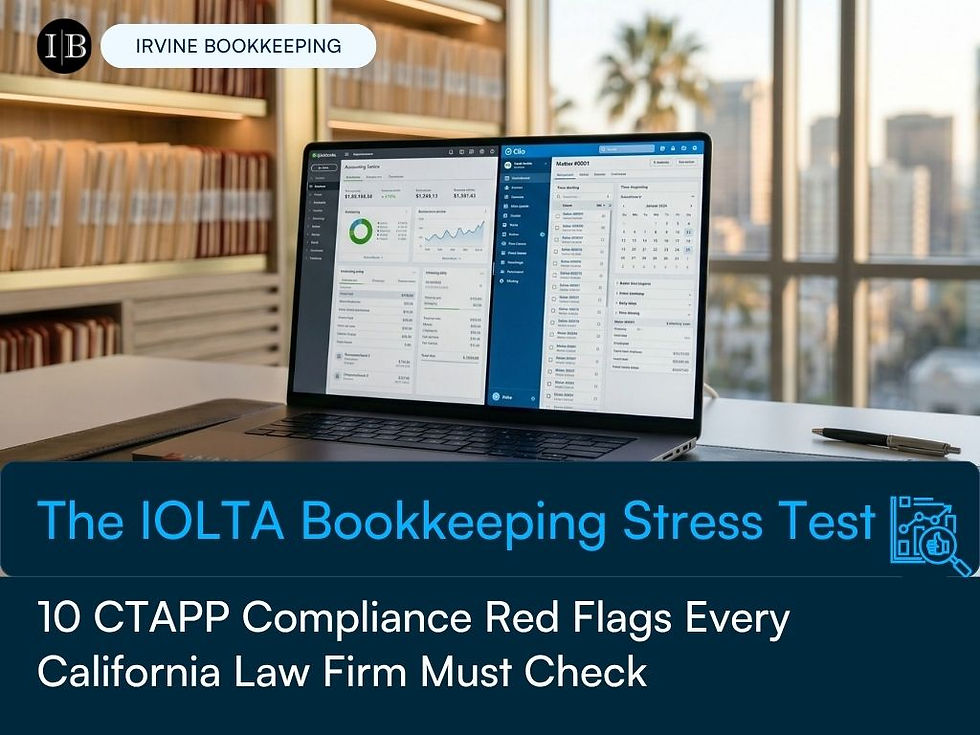
Clio, MyCase, PracticePanther, Filevine, Casepeer, Smokeball — your practice management software tracks matters and billing, but it does not replace law firm bookkeeping. Your QuickBooks (or Sage) trust accounts must reconcile to what your practice management says clients owe and what their trust balance is. If those two systems disagree, your law firm trust accounting is wrong somewhere — and you do not know where

Question 8: Are You Properly Handling IOLTA Bank Fees?
Bank fees on IOLTA accounts are tricky. The State Bar Foundation typically covers reasonable IOLTA fees, but credit card processing fees, wire fees, and other charges may need to come from your operating account. If your IOLTA bookkeeping shows your trust account paying its own bank fees, you may be unintentionally using client funds for firm expenses. Most attorneys bookkeeping setups handle this incorrectly and do not realize it.

Question 9: Could You Produce 5 Years of IOLTA Records Within 48 Hours?
California requires you to retain IOLTA records for 5 years minimum. If the State Bar contacts you tomorrow with a CTAPP audit notice, you have a very short window to produce: monthly 3-way reconciliations, all client ledgers, every deposit slip, every disbursement record, and every bank statement. If your law firm bookkeeping is not organized for instant retrieval, you are not CTAPP-ready. Real audit readiness is daily discipline, not last-minute scrambling.

Question 10: Who Actually Does Your Law Firm Bookkeeping?
If the answer is you—at midnight, between client calls — your IOLTA bookkeeping is at risk. If the answer is your spouse, your office manager, or a generic small business bookkeeper without IOLTA experience, your trust accounting is at risk. Looking up bookkeeping near me on Google and hiring whoever shows up first is how attorneys end up in front of the State Bar. Specialized law firm bookkeeping requires specialized law firm bookkeepers.

Score Your IOLTA Bookkeeping Stress Test
Count the questions where you answered yes (or were unsure): 0 to 1 yes—your law firm trust accounting is solid. Maintain monthly 3-way reconciliation discipline. Keep your law firm operating expenses cleanly separated from IOLTA. 2 to 4 years—significant CTAPP exposure. Get a professional IOLTA bookkeeping review before your next State Bar inquiry. 5+ yes — your trust accounting needs immediate attention. Catch-up law firm bookkeeping cleanup is the priority. Every day you wait is another day of CTAPP risk.

Stop Worrying About Your Trust Account. Start Knowing It Is Done Right.
Imagine your next CTAPP report being a 5-minute paperwork exercise instead of a license-threatening event. Picture clean books, perfect 3-way reconciliation, and complete audit-ready records every single month. That reality is one consultation away. Whether you need a one-time catch-up law firm bookkeeping cleanup, ongoing monthly IOLTA bookkeeping, or specialized personal injury law firm bookkeeping with high-volume settlement tracking, our team handles it. Stop searching for bookkeeping near me at midnight. Start working with attorneys' bookkeeping specialists who do this every day. Yes — book your free 30-minute IOLTA review with Tammy Hoang, CFMA, today.


An IOLTA stress test should confirm that client funds, ledgers, reconciliations, transfers, and supporting records can withstand detailed review. Compliance failures may begin as small bookkeeping errors, yet they can damage trust quickly when nobody investigates them. In research outside the accounting records, binder and binder connects customer experiences with questions about communication, case expectations, and problem handling. Clients should apply the same caution before relying on a legal-service provider for a serious matter. Strong financial controls and responsible client care are both necessary signs of a trustworthy practice.
Drive Mad isn’t just about speed—it’s about timing, strategy, and learning from mistakes. Every crash teaches something new, which makes victories even sweeter.