
Three-Way Reconciliation for Law Firms: How It Actually Works, Step by Step
- Irvine Bookkeeping

- 3 hours ago
- 6 min read
By Tammy Hoang, Certified QuickBooks ProAdvisor

Every state bar in the country requires attorneys handling client trust funds to reconcile their trust accounts regularly, and nearly every one of them expects something more rigorous than a standard bank reconciliation. That standard is three-way reconciliation: confirming that three separate numbers — the trust account's bank statement balance, the firm's internal trust ledger, and the sum of every individual client's ledger balance — all match exactly, every single month. Most generalist bookkeepers have never performed one, because it does not exist anywhere in ordinary business accounting.
This guide walks through what three-way reconciliation actually requires, why a simple one-way bank reconciliation is not sufficient for trust accounting, and what the process looks like month to month for a law firm handling client funds.
This single discipline is arguably the clearest dividing line between real law firm bookkeeping and general small-business bookkeeping applied to a legal practice. A generalist may keep clean books in every other sense and still never have learned to perform three-way reconciliation correctly, simply because nothing in standard bookkeeping training covers it.
The Three Numbers That Have to Match
A three-way reconciliation gets its name from the three separate figures being compared. The first is the bank statement balance for the trust account itself — the actual cash sitting at the financial institution. The second is the trust ledger balance, the firm's own internal accounting record of total trust funds held. The third is the sum of every individual client ledger — each client's specific portion of the pooled trust account, added together across every active matter.
If all three numbers agree, the trust account is in balance. If any one of them differs from the other two, a discrepancy exists somewhere in the system, and it has to be investigated and resolved immediately — not carried forward to the next reconciliation cycle in the hope it corrects itself. It almost never does.
Why a Standard Bank Reconciliation Isn't Enough

Most bookkeepers are trained to perform a simple bank-to-book reconciliation: matching the bank statement to the accounting software's recorded balance. For ordinary business accounts, that single check is sufficient. For a law firm's trust account, it is dangerously incomplete, because it only confirms that the total pool of trust money is accurate — it says nothing about whether that money is correctly allocated across the individual clients it belongs to.
A pooled trust account can reconcile perfectly against the bank statement while individual client balances underneath it are quietly wrong — one client's funds effectively covering a shortfall in another client's balance, invisible unless someone checks each client ledger against the total. This is precisely the scenario three-way reconciliation is designed to catch, and precisely what a one-way bank reconciliation will always miss.
Is Your Firm Actually Performing Three-Way Reconciliation Every Month?
Irvine Bookkeeping performs disciplined three-way reconciliation and gets your trust accounting review-ready.
Call or Text: (949) 482-2790 | irvinebookkeeping.com
How the Reconciliation Process Actually Works, Step by Step

The process starts by pulling the trust account's bank statement for the period and confirming the ending balance. Next, the firm's internal trust ledger — the master record of all trust activity — is totaled for the same period. Then, every individual client ledger active during that period is pulled and summed. All three numbers are compared side by side.
If they match: the reconciliation is documented and filed as evidence of ongoing compliance, ready to be produced if a bar audit or client inquiry ever asks for it.
If they don't match: the firm traces backward through the period's transactions — deposits, disbursements, transfers — looking for a data-entry error, a transaction posted to the wrong client, a timing difference between when a check was written and when it cleared, or a genuinely missing entry.
Once the discrepancy is found: it is corrected at the source, not simply adjusted with a plug entry that makes the numbers match without explaining why they didn't in the first place.
This process is what three-way reconciliation actually means in practice — not a single number check, but a full verification loop that confirms the pooled trust account and every individual client's slice of it are both accurate, together.
Common Sources of Discrepancy

The most frequent cause of a broken three-way reconciliation is a transaction posted to the wrong client ledger — a deposit or disbursement recorded correctly at the bank and correctly in the total trust ledger, but attributed to the wrong individual client. The pooled totals still match, but the client-level detail is wrong, which is exactly the kind of error a bank-only reconciliation would never surface.
Timing differences — a check written and recorded in the books but not yet cleared by the bank at month end.
Bank fees or errors posted directly against the trust account without a corresponding internal entry.
Disbursements recorded before a deposit has actually cleared, creating a temporary trust shortfall if the deposit is later returned.
Manual data-entry mistakes — a transposed number, a missing entry, a duplicate posting.
Every one of these is findable through disciplined monthly three-way reconciliation and difficult or impossible to catch through any less rigorous process.
Consider a firm managing 40 active client matters through one pooled trust account. A single disbursement of $2,000 posted to the wrong client's ledger — the money actually paid out correctly, just attributed to the wrong matter internally — leaves the bank statement and the total trust ledger both perfectly accurate. Only three-way reconciliation catches it, because only that process checks whether each individual client ledger, not just the pooled total, actually reflects reality. A firm relying on a one-way bank reconciliation would never see this error at all — the numbers that matter to a bank reconciliation would look completely fine.
Documentation: Proving the Reconciliation Actually Happened
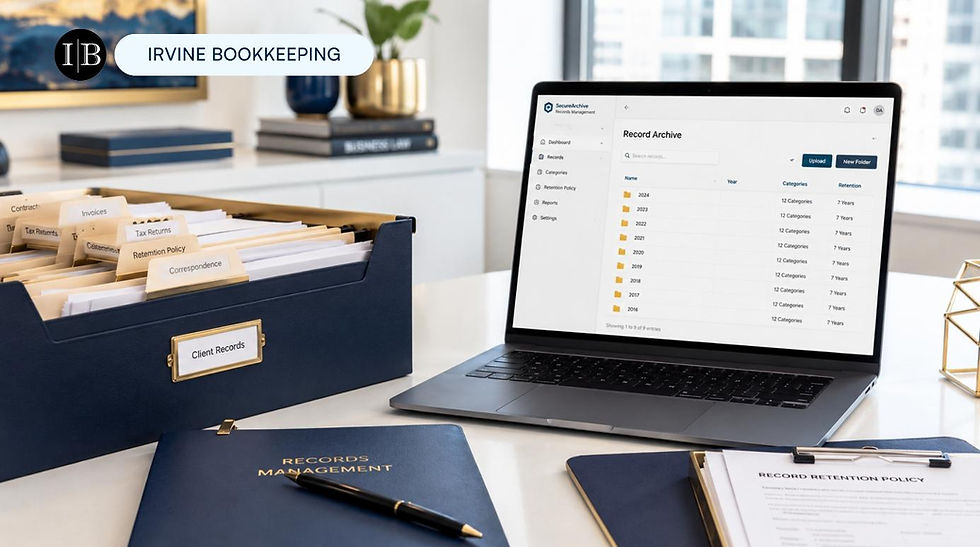
Performing three-way reconciliation is only half the requirement — most state bars also expect the reconciliation itself to be documented and retained, often for five to seven years depending on the state. A firm that reconciles diligently but keeps no record of having done so is in nearly the same position, from a compliance-review standpoint, as a firm that never reconciled at all — there is simply no evidence either way.
This documentation requirement is easy to underestimate until a bar audit or a client dispute actually asks for it. A dated, saved reconciliation report for every single month is worth far more during a compliance review than a firm's word that reconciliation "generally happens." The paper trail is the proof, and building it consistently, month after month, is what turns three-way reconciliation from a good habit into a defensible compliance record.
If a revenue or classification question ever affects the firm's tax return, the underlying accounting rules are federal and factual; the IRS addresses accounting methods and recordkeeping basics in IRS Publication 538, Accounting Periods and Methods. Documented three-way reconciliation supports both bar compliance and a defensible tax position at the same time.
How Irvine Bookkeeping Handles Three-Way Reconciliation

At Irvine bookkeeping, three-way reconciliation is performed and documented every single month for every client trust account we manage — bank statement, trust ledger, and individual client ledgers, all confirmed to match, with the reconciliation itself retained as evidence of ongoing trust accounting compliance. This is the standard our law firm bookkeeping is built on, and the same standard the bookkeeping services Orange County law firms trust are held to every month.
If you have been searching for a bookkeeper near me who actually performs three-way reconciliation correctly, rather than a simplified bank-only check, that is precisely what our law firm bookkeeping delivers. We keep every client ledger accurate and review-ready, with documentation built to withstand a real compliance review. It is the difference between hiring any bookkeeper near me and hiring one who has actually performed three-way reconciliation for law firms before.
Whether you need disciplined three-way reconciliation, a trusted local bookkeeper near me, or full-service bookkeeping services Orange County law firms can rely on, our team makes sure your trust accounting is reconciled correctly every month, not just checked against the bank statement and called done. Dependable bookkeeping services Orange County attorneys trust starts with reconciliation done right.

Get Real Three-Way Reconciliation for Your Firm
Talk with Irvine Bookkeeping about disciplined trust account reconciliation.
Call or Text: (949) 482-2790 | irvinebookkeeping.com


Comments