
New Jersey's Random Audit Program: What Happens When the OAE Picks Your Trust Account
- Irvine Bookkeeping

- 3 hours ago
- 3 min read
By Tammy Hoang, Certified QuickBooks ProAdvisor

New Jersey runs one of the oldest and most active attorney trust account audit programs in the country. The Office of Attorney Ethics has operated a Random Audit Compliance Program since the early 1980s and a Trust Account Overdraft Notification Program since 1985, and together they support what New Jersey's own regulators call a "culture of compliance." Selection is random. You do not have to do anything wrong to be picked.
A 2024 comparison found New Jersey paid out roughly $1.1 million in client fund theft reimbursements over a twelve-month period — a fraction of what states without an active random audit program pay out in the same span. New Jersey's regulators credit their proactive audit structure directly for that gap.
This article explains how New Jersey's random audit actually works, what the Office of Attorney Ethics asks for, and what a firm's books need to look like before the letter arrives.
Two Programs Working Together
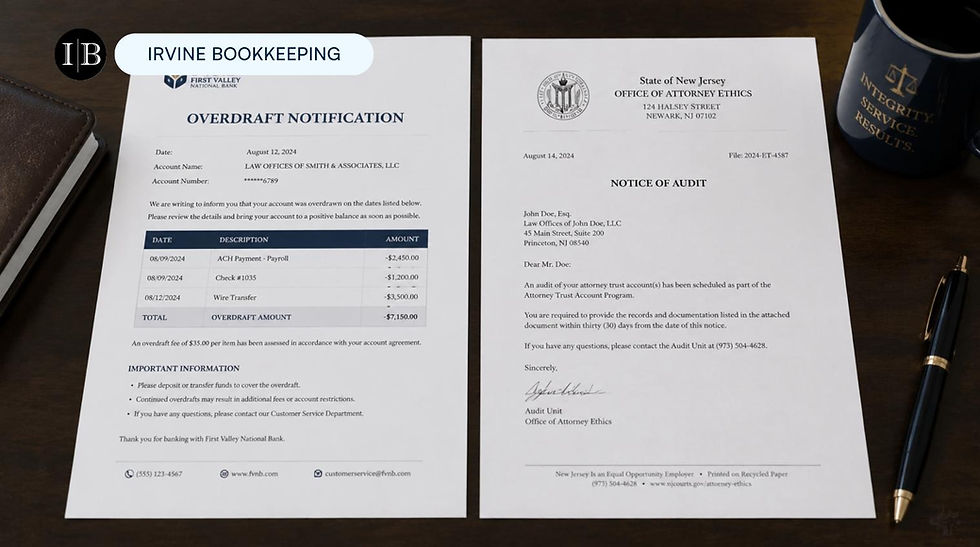
New Jersey's oversight runs on two connected mechanisms. The Trust Account Overdraft Notification Program requires every approved financial institution holding attorney trust funds to automatically report any check or electronic debit presented against insufficient funds directly to the Office of Attorney Ethics — no attorney reporting required, no discretion involved. The Random Audit Compliance Program separately selects law firms by computer, with every firm carrying an equal chance regardless of size.
An attorney can go years without an overdraft and still be selected for a random audit purely by the computer's selection process. The two programs catch different failure modes: overdrafts catch active shortfalls in real time; random audits catch quiet noncompliance that never triggers a bounced check at all.
Selected for a New Jersey Random Audit?
Book a 30-minute call with Irvine Bookkeeping.
Call or Text: (949) 482-2790 | irvinebookkeeping.com
What Happens During the Audit
A New Jersey random audit generally takes half a day to a full day and is handled by a single Office of Attorney Ethics auditor. The attorney should be present, or a person with detailed knowledge of the firm's books and records must be available in their place. The auditor conducts an initial interview about recordkeeping procedures, then reviews the required records against Rule 1:21-6 and RPC 1.15.
At the end, the auditor produces an audit deficiency form listing any findings. Mild, correctable deficiencies typically just require the firm to verify corrections were made. More serious findings can lead to a continued audit on another date or, in the worst cases, an ethics grievance.

The Records the Auditor Requires
Rule 1:21-6 requires every New Jersey attorney in private practice to maintain at least two accounts — a trust account and a business account — with records reconciled to each other at least monthly. The auditor expects a general ledger recording all trust activity, bank statements, canceled checks, deposited items, individual client ledgers, and a genuine three-way reconciliation report matching the adjusted bank balance, the ledger balance, and the sum of every client's balance.
Records must be retained for seven years after a matter concludes. Attorneys cannot delegate away the ultimate duty to review this work — hiring a bookkeeper or accountant does not shift responsibility away from the attorney, and "my bookkeeper handled that" is not accepted as a defense during a disciplinary audit.

The Bright-Line Rule
New Jersey has a bright-line policy calling for automatic disbarment of attorneys who knowingly misappropriate client funds — no mitigation, no case-by-case weighing once knowing misappropriation is established. That severity is precisely why New Jersey's regulators invest so heavily in catching problems early, before a shortfall becomes a misappropriation finding.
Most attorneys caught in a serious trust account finding did not set out to misappropriate anything. A negative client ledger from a disbursement made before funds cleared, or an earned fee left sitting in trust, is how the pattern usually starts — the same operational drift seen in every state that audits trust accounts seriously.

Get Your New Jersey Trust Records Audit Ready.
Talk with Irvine Bookkeeping about disciplined New Jersey trust accounting.
Call or Text: (949) 482-2790 | irvinebookkeeping.com
How Irvine Bookkeeping Helps New Jersey Law Firms
New Jersey's random audit rewards firms that already have the discipline in place — monthly three-way reconciliation, individual client ledgers, and seven years of organized records — long before the computer ever selects their file.
Irvine Bookkeeping prepares monthly reconciliations and maintains client ledgers built to withstand an Office of Attorney Ethics review, whatever the trigger. QuickBooks certified.

Get Your New Jersey Trust Records Audit Ready.
Book a 30-minute call with Irvine Bookkeeping.
Call or Text: (949) 482-2790 | irvinebookkeeping.com


Comments