
The Bookkeeping Mistake That Inflates an MSP's Revenue: Why Annual Contracts Can't Be Booked as Cash

By Tammy Hoang, Certified QuickBooks ProAdvisor

A managed service provider signs a client to an annual support contract, collects the full year up front, and books the entire payment as revenue the month it lands in the bank. On paper, that month looks fantastic. The problem is that the client hasn't received eleven of the twelve months of service yet — which means most of that monthly recurring revenue was never actually earned in the month it was recorded. This single error is the most common and most damaging mistake in MSP bookkeeping, and it quietly distorts everything downstream: margins, tax liability, and every decision made off the P&L.
Getting IT managed service provider bookkeeping right means understanding that an MSP is not one kind of business — it runs three revenue models at once, each with its own accounting rules, and treating them all the same way is exactly what generic bookkeeping gets wrong. An owner who has never seen the difference laid out often assumes their books are simply “close enough,” right up until a lender, buyer, or tax preparer asks a question the current reports cannot answer.
This is not a rare edge case. It is the single most common problem we see when reviewing a new client's books, and it is exactly why generic MSP bookkeeping done by someone unfamiliar with the industry produces numbers that look fine on the surface and are quietly wrong underneath. The rest of this article walks through what real MSP bookkeeping has to get right.
Deferred Revenue: Why Prepaid Contracts Are a Liability, Not Income
This is the core mechanic every MSP owner needs to understand. When a client prepays an annual support contract, that cash is not fully earned revenue on day one — it is deferred revenue, a liability on the balance sheet representing service the MSP still owes. As each month of support is actually delivered, a portion of that deferred revenue converts to earned income. Recording the whole payment as revenue in month one overstates that month by as much as twelve times its real value, and understates every month that follows.
This is what recurring revenue recognition actually means in practice: revenue is recognized ratably over the period the service covers, not on the date cash arrives. An MSP running twenty or thirty annual contracts, each started on a different month, needs deferred revenue tracked contract by contract — something no bank feed or transaction-categorization tool can do on its own, because the software has no way of knowing which invoice covers which service period.
Consider an MSP that signs five new annual contracts in January, each worth $24,000. Booked incorrectly, January shows $120,000 in revenue and every other month of the year shows nothing from those contracts — a wildly misleading picture. Recognized correctly through deferred revenue, each contract contributes $2,000 a month for twelve months, so January shows $10,000 from those five clients and every subsequent month shows the same steady $10,000. That is the difference between books that mislead and books that actually reflect the business.
Three Revenue Streams, Three Sets of Rules

Beyond the deferred-revenue trap, managed services accounting has to handle three genuinely different income types simultaneously, and each demands its own treatment.
Recurring managed services. The core monthly recurring revenue from ongoing support contracts, billed monthly or prepaid annually, subject to the recurring revenue recognition rules above.
Hardware and software resale. When an MSP buys equipment or licenses and resells them to a client at a markup, that sale carries real cost of goods sold — vendor cost against resale price — and needs to be tracked as its own margin, separate from managed services income.
Project and implementation work. One-time engagements like a network migration or a new office build-out are recognized as the work is completed, closer to a standard service-business model, not spread over a contract period.
Blend all three into one undifferentiated revenue line and an MSP owner loses the ability to see which part of the business is actually profitable — recurring support might be carrying the whole company while hardware and software resale quietly loses money on every deal. This is exactly why managed services accounting has to separate all three from the start rather than trying to untangle them a year later.
Is Your MSP's Revenue Actually as Strong as It Looks?
Irvine Bookkeeping untangles deferred revenue and gets your reporting review-ready.
Call or Text: (949) 482-2790
Accounts Receivable Across Mixed Billing Cycles
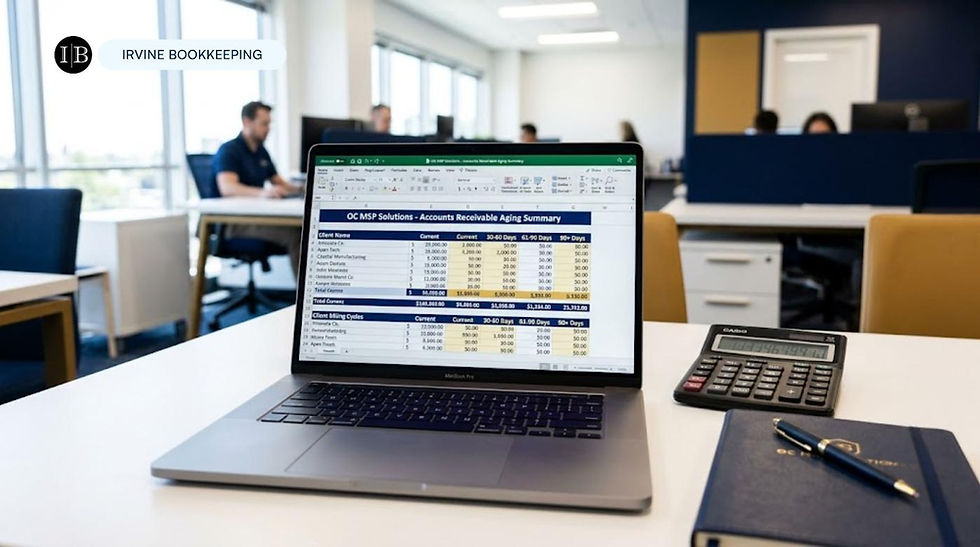
Because an MSP bills clients on different cycles — some monthly, some annual, some milestone-based for projects — accounts receivable tracking has to account for each contract's own schedule. A generic aging report that treats every invoice the same way cannot tell an owner whether a monthly client is thirty days late or whether an annual renewal simply hasn't come due yet.
Clean accounts receivable management at this level requires tracking each client's billing cadence individually, so a real collections problem doesn't get lost in the noise of contracts that are functioning exactly as designed. This is a level of detail that separates genuine IT managed service provider bookkeeping from a generic service that simply reconciles a bank feed and calls the job done.
Accounts Payable to Vendors and Software Providers

On the other side of the ledger, an MSP typically owes recurring payments to dozens of software vendors and cloud providers — licensing fees that scale with client count, often billed monthly regardless of when the MSP itself gets paid. Accounts payable for an MSP is not a handful of vendor bills; it is an ongoing web of subscription costs that has to be reconciled against which clients are actually using which licenses.
When accounts payable isn't tracked at the vendor-and-client level, MSPs routinely keep paying for licenses tied to clients who have already churned — a quiet, recurring cost leak that generic bookkeeping rarely catches because nothing about it looks like an error on the surface.
This leak compounds over time in a way that is easy to miss month to month. A handful of unused licenses at $50 a month feels trivial; a year of accumulated unused licenses across dozens of former clients can quietly cost an MSP thousands of dollars in margin that never shows up as a single obvious mistake, only as a slowly eroding accounts payable total that no one ever stops to reconcile against the current client roster.
Building the Structure That Handles All of This

The fix is structural. QuickBooks for MSPs needs a chart of accounts that separates monthly recurring revenue from project revenue and hardware and software resale, tracks deferred revenue as its own liability account reduced monthly as service is delivered, and reconciles accounts payable against active client licenses.
If a revenue-timing question ever affects the tax return, the underlying rule is federal and factual: the IRS addresses accounting methods and when income is recognized in IRS Publication 538, Accounting Periods and Methods. Building recurring revenue recognition correctly on the books is what keeps an MSP's numbers — and its tax position — accurate. This is exactly the standard the bookkeeping services Orange County MSPs depend on are held to, month after month.
How Irvine Bookkeeping Helps Orange County MSPs

At Irvine bookkeeping, our MSP bookkeeping is built around the three-revenue-stream reality of your business. We track deferred revenue contract by contract, separate monthly recurring revenue from hardware and software resale margin, and keep accounts receivable and accounts payable reconciled against your actual client and vendor relationships.
If you have been searching for a bookkeeper near me who understands why an annual contract isn't a windfall the month it's paid, that is precisely what our IT managed service provider bookkeeping delivers. We keep your QuickBooks for MSPs accurate and review-ready, so your revenue finally reflects the service you have actually delivered. It is the difference between hiring any bookkeeper near me and hiring one who has managed deferred revenue before.
Whether you need clean managed services accounting, a trusted local bookkeeper near me, or full-service bookkeeping services Orange County MSPs can rely on, our team makes sure your books tell the truth about what you have earned. Dependable bookkeeping services Orange County managed service providers trust is the foundation every growing MSP needs, and clean QuickBooks for MSPs is where it starts.
Get Your Recurring Revenue Recognized Correctly
Talk with Irvine Bookkeeping about MSP-specific bookkeeping built for your business.
Call or Text: (949) 482-2790


Contacts on https://softdoes.com/locations/kansas/kansas-city/mobile-app-development I had the pleasure of utilizing the mobile app development services offered in Kansas City, and I must say, the experience was exceptional. The team demonstrated a remarkable level of professionalism and expertise, guiding me through each step of the development process with clarity and precision. The final product exceeded my expectations, showcasing a user-friendly interface and seamless functionality. I was particularly impressed by their attention to detail and commitment to delivering a high-quality application tailored to my specific needs. Overall, I highly recommend their services to anyone seeking reliable and innovative mobile app solutions.
With easy-to-learn rules and endless challenges, solitaire remains a favorite choice for casual gamers of all ages.